
What's new

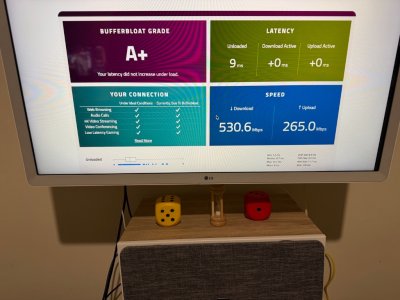
Endgame Bufferbloat Results: RT-AX86U Pro + CAKE SQM (+0ms Active Latency)".

Fonpap

New Around Here
Finalizing my custom SQM setup on RT-AX86U Pro (1000/500 FTTH). Statistical perfection achieved under full load. +0ms Active Latency, +0ms Jitter. This router is Endgame.

To put things into perspective, here is a simultaneous stress test (ping 1.1.1.1 -c 500) while running the Bufferbloat test:

• Average: 6.092 ms
• Max Spike: 11.295 ms
• Stddev (Jitter): 0.461 ms
• Packet Loss: 0.0%

Zero packet loss, zero jitter. The CAKE script is holding the line perfectly.
 

Attachments
  • IMG_3299.jpeg
    IMG_3299.jpeg
    223.9 KB · Views: 7
Last edited:
What are your CAKE settings? What results did you have with QoS disabled? Just curious.
 
I thought Cake capped out around 300mbps?
 
I’m running a custom JFFS script to handle CAKE SQM, fine-tuned for my 1000/500 FTTH line. Settings are optimized with a strict overhead and manual bandwidth caps to ensure that 0ms deviation.

Without QoS, the line is still fast, but the active latency spikes are noticeable (standard bufferbloat). The goal here wasn't just speed, but "Lab Perfect" consistency for competitive gaming.

I’ll share more details once I finalize some more stress tests!
 
I thought Cake capped out around 300mbps?

The secret to pushing CAKE past 500Mbps on the RT-AX86U Pro is all about CPU affinity and interrupt handling.

By manually binding the network interface interrupts to specific CPU cores, you prevent a single core from bottlenecking. When you distribute the processing load across all four cores, the router can handle the SQM overhead much more efficiently.

It’s the only way to achieve +0ms active latency and sub-1ms jitter at these speeds.
 
I’m running a custom JFFS script to handle CAKE SQM, fine-tuned for my 1000/500 FTTH line. Settings are optimized with a strict overhead and manual bandwidth caps to ensure that 0ms deviation.

Without QoS, the line is still fast, but the active latency spikes are noticeable (standard bufferbloat). The goal here wasn't just speed, but "Lab Perfect" consistency for competitive gaming.

I’ll share more details once I finalize some more stress tests!
 
What are your CAKE settings? What results did you have with QoS disabled? Just curious.

With QoS disabled at full line speed (1000/500 Mbps), I was getting a Bufferbloat Grade A, with +13ms on Download Active and +25ms on Upload Active. While those results were decent, they weren't "Lab Perfect" for my standards.

By utilizing CAKE SQM with an aggressive undershoot (550/275 Mbps) and manually balancing the interrupts across all CPU cores, I managed to lock it at +0ms/+0ms with sub-1ms jitter.

The core of the optimization is this command:

tc qdisc replace dev ppp0 root cake bandwidth 275mbit diffserv3 dual-srchost nat nowash no-ack-filter split-gso rtt 100ms noatm overhead 34 && tc qdisc replace dev ifb4ppp0 root cake bandwidth 550mbit besteffort dual-dsthost nat wash ingress no-ack-filter split-gso rtt 100ms noatm overhead 34 && echo "f" > /proc/irq/$(grep -m1 ppp0 /proc/interrupts | cut -d: -f1)/smp_affinity
 

Latest threads

Support SNBForums w/ Amazon

If you'd like to support SNBForums, just use this link and buy anything on Amazon. Thanks!

Sign Up For SNBForums Daily Digest

Get an update of what's new every day delivered to your mailbox. Sign up here!
Back
Top