I've seen similar claims - Qualcomm IPQ8065 is a good example - It's a dual-core Qualcomm Krait, also also includes two ubi32 nss cores - I've seen some quote this as a quad-core setup, which is technically true, but I would consider it a dual-core chipset...
It's much like quoting the entire aggregate bandwidth of a tri-band device rather than the realistic numbers..
But hey, it's marketing at the end of the day...
Yeah it's marketed as a quad on QCA site

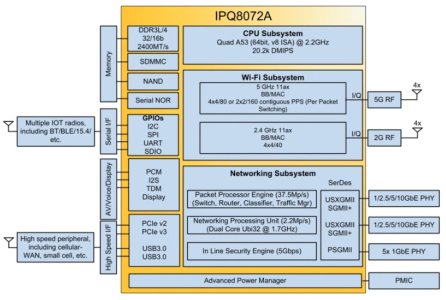
Not sure if they ever changed it for current BE generation, but AX gen IPQ8072/A was similar with NSS on chip. Original clock speed was 1.5ghz at launch.. Got boosted to 1.7ghz with "A" revision.
So.. we kinda have to look at this two ways.. Do SoCs actually count? I mean BCM just pools everything.. I'd consider something like a "BCM6755" more like a dual core with a weaker A7 design given all "radio" functionality has to mesh in main pool.
The high end BCM designs are more linear to whatever QCA is doing for most chips, granted I never looked into the cheaper units.
IE: IPQ8072A + 4x4 + 4x4 chip is linear to a BCM4912 + 4x4 + 4x4 with NSS/NPU on radio side.
Edit: Also want to mentioned... Where previous Broadcom AC W2 3x3 chips had 800mhz A7s for NPU functionality (the original "Penta core"), current BCM6710 (3x3) or BCM6705 (2x2) will load off a main CPU like the traditional 3x3 BCM4360.
So you theoretically have even less CPU functionality if you were to pair something like a gen 1 or 2 AX BCM675X SoC with a 6705 for a 2x2+2x2+2x2 triband design.
Is it fair for Broadcom and manufacturer to market it as a quad core?
Something like an AX88U PRO woud have a true A53 quad + 1.7ghz NPU functionality separate to each 6715 4x4 radio. Which is closer to What Qualcomm does in one bigger SoC.